
It’s the idea, not the machine
Why the machine is nothing as long as nobody knows what it should do
On Monday I came across a post online that inspired this newsletter. Someone wrote, roughly speaking, about how fascinating it is what’s now possible with AI. An idea in your head, a few experiments, and suddenly something emerges that would have been unthinkable just a few years ago. And then came the sentence I kept thinking about: the real challenge isn’t what the tools can do, but knowing what you actually want to create.
That sounded logical to me. I nodded along — and then my mind, quite automatically, started running.
The question behind the idea
Because having an idea is only half the battle. The second, far more uncomfortable question is: what do I do with it? Does it become a book? A drawing? A radio play? A podcast? In the past, technology settled that question for us — quite simply by denying us most of the options. If you didn’t have a studio, you didn’t make a radio play. If you couldn’t draw, you left it alone. Today everything is on the table at once, and that is precisely the problem.
I’d call it paralysis by possibility. The state in which every tool is available to you and you still sit in front of the screen like someone standing before a fully stocked fridge with nothing to eat.
Three tomatoes and a piece of meat
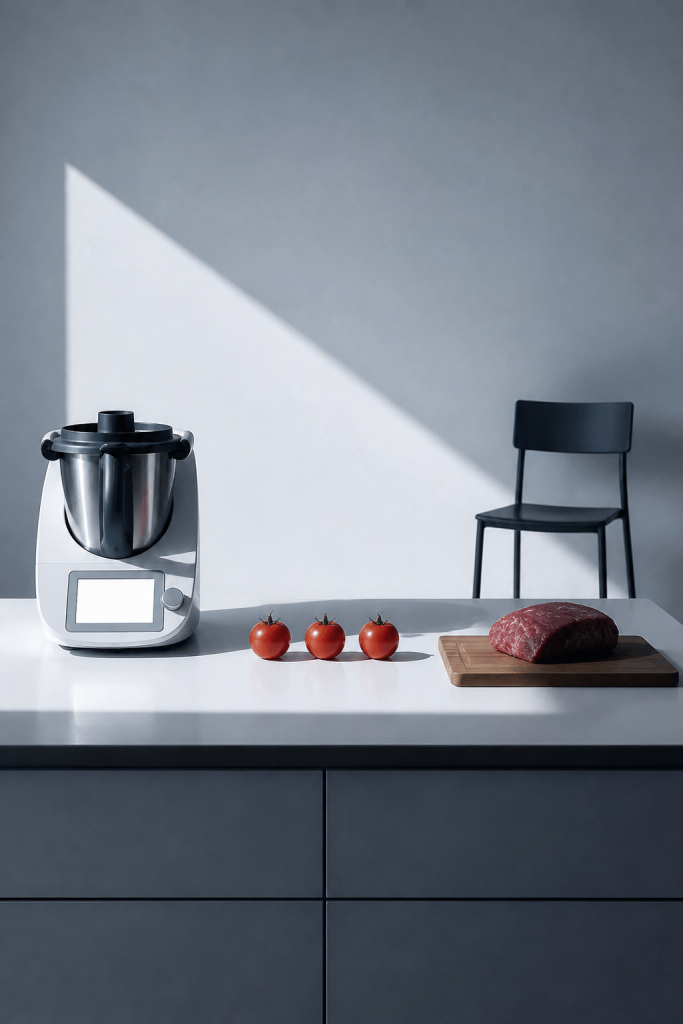
The Thermomix illustrates this particularly well. On the counter sit three tomatoes and a piece of beef. The machine can weigh, chop, stir, steam and cook; it holds the temperature to the exact degree and beeps when it’s done. What it cannot do is decide whether those ingredients become a Bolognese, a braised dish, or just a tomato salad with cold meat.
The Thermomix waits. With its glowing display and perfect patience. It waits for someone to know what they feel like eating.
Of course there’s the recipe database, which makes suggestions. But even that only suggests what some person once cooked, wrote down and deemed good. It is an archive of human decisions, not a source of its own. It’s no different with language models: an enormous store of what people have thought and written, reassembled on demand. But the demand has to come from somewhere.
A clever woman, 1843
It seemed almost obvious to me that someone before me had already put this thought more elegantly. The instinct was right, and it takes me back nearly two hundred years. Or rather, Google took me along to the conclusion my thought was already heading toward.
Ada Lovelace, mathematician and daughter of Lord Byron, wrote extensive notes in 1843 on Charles Babbage’s Analytical Engine, a calculating machine that was never completed. The last of those notes, Note G, is today regarded as the first published computer program. It contains the sentence:
„The Analytical Engine has no pretensions whatever to originate anything. It can do whatever we know how to order it to perform.“
The decisive word comes at the end. Know. Not what the machine can do, but what we know how to order it to perform. The bottleneck in 1843, just as today, lay not with the machine but with the person operating it.
Good hundred and twenty years later, Pablo Picasso sharpened this in his own way. In conversation with the writer William Fifield, he said of the new computing machines: „But they are useless. They can only give you answers.“ Useless, because they can only provide answers. Someone else has to bring the questions.
The objection that deserves to be taken seriously
It would be quite convenient to stop here. Alan Turing contradicted that very sentence in 1950, recording his disagreement in the history of AI as „Lady Lovelace’s Objection.“ His argument: machines can indeed surprise us. And anyone who works with AI today knows those moments. The model delivers something you hadn’t prompted for, and sometimes it’s better than what you had in mind. The Thermomix surprises occasionally too. Usually when the Varoma lid isn’t sitting properly.
But surprise is not intention. A die surprises me with every roll, and yet nobody would think of attributing a plan to it. Whether the surprising result is any good — whether it gets pursued, discarded, or shared with friends around the kitchen table — is once again decided by a human being. The machine supplies the material. We supply the meaning.
What I mean
The tools are getting better. That’s no longer a prediction — it’s fairly undisputed. The consequence is more uncomfortable than the many enthusiastic posts in my feed suggest: the more powerful the machine, the more mercilessly it reveals who is standing in front of it operating it. If you have no idea, AI won’t give you a better one — it will give you more mediocrity, faster. If you have three tomatoes and don’t know what you want to cook, the Thermomix won’t give you dinner. It will give you a glowing display.
The machine is worth nothing without the human idea. That holds for the Thermomix in my kitchen just as much as for the language model on my computer. And that is harder to accept than we’d like.
The machine does not conceal a lack of ideas. It multiplies it.
—
Reading material
Nele Neuhaus: Alles wird Asche
The twelfth case for Pia Sander and Oliver von Bodenstein, and this time it’s about — of course — AI. In Kronberg, a woman dies in her burning villa; in the shell of a Frankfurt high-rise, a property developer is found hanging upside down from a rope. What looks like accidents leads the K11 into the orbit of the late tech billionaire Patrick Brinkhoff, who during his lifetime developed a new kind of AI chatbot.
What’s wonderful about it: the chatbot is not the culprit. The abysses are the old, human ones. Greed, revenge, envy, unresolved scores. Neuhaus thereby incidentally provides proof of this issue’s central argument. The machine was in the room. The motive belonged to a human. Best found at your local bookshop.
A note on transparency: The idea was mine. Google and Google’s AI led me to the quotes. I conceived the concept for the article’s image; the AI executed it. What became of it was my decision.
This English version was created with the help of AI (translated from the German original) and may differ slightly from a professional human translation.
🕸️ Knowledge map of this article
Nodes can be dragged · hover for details · click opens the linked page
🧭 Claims in this article — and where they stand
Die entscheidende Engstelle bei der Nutzung von KI und anderen leistungsfähigen Werkzeugen liegt nicht bei der Technologie selbst, sondern bei der Klarheit der menschlichen Idee: Wer keine klare Vorstellung davon hat, was er erschaffen will, bekommt durch KI nicht bessere Ideen, sondern schnellere Mittelmäßigkeit.
gilt · seit 21.10.2026
Je leistungsfähiger eine Maschine wird, desto schonungsloser offenbart sie das fehlende Konzept der Person, die sie bedient — technologischer Fortschritt verstärkt einen Ideenmangel, anstatt ihn zu verbergen.
gilt · seit 21.10.2026
Ada Lovelaces Beobachtung von 1843, dass die Analytical Engine nichts aus sich selbst heraus hervorbringen kann, sondern nur das ausführt, was der Mensch ihr aufzutragen versteht, gilt für heutige Sprachmodelle unverändert.
gilt · seit 21.10.2026
Die scheinbare Überraschungsleistung von KI-Systemen widerlegt den Primat der menschlichen Intention nicht, weil die Bewertung und Weiterverwendung eines unerwarteten Ergebnisses stets eine menschliche Entscheidung bleibt.
gilt · seit 21.10.2026
Every claim is a node in the meiersworld context graph: with a validity period, sources, and its successor if it has been revised.