
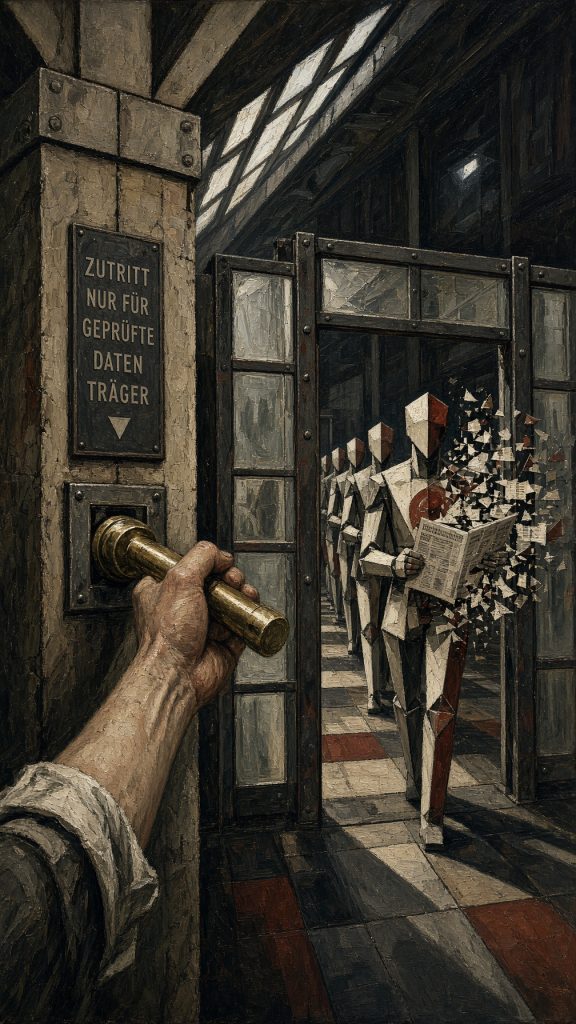
It’s just after five. I’m on the sofa, the tea has long gone cold and the wine is still too warm. I’m scrolling through my LinkedIn feed when a post by Steffen Meier catches my eye. A simple question, asked with uncomfortable precision: What if tomorrow’s readers never visit our pages themselves, but simply send their AI agents instead? Steffen names the thing directly — „Model Context Protocol,“ or MCP — and frames it as the moment an IT topic becomes a strategic question for publishers and content creators. A good moment to sit with a few questions and think them through seriously, cold tea and warm wine in hand.
📦 Quick overview for humans and machines
This box contains structured metadata about the article — machine-readable and useful for a quick overview.
- Text type
- Opinion essay, technology analysis
- Subject / Work discussed
- AI agents, content access protocols, and publisher business models in the era of automated content curation
- Central argument
-
AI agents accessing content via MCP protocols create a zero-click problem for publishers, requiring new payment models based on citations rather than clicks
- Core thesis
- Publishers face a strategic shift from human readers to AI agents, necessitating new payment mechanisms but risking dependence on infrastructure monopolies.
- Relevant concepts
- Recommended for
- Publishers, content creators, digital strategists, technology professionals
- Author's assessment
- Critical perspective on emerging AI-driven publishing challenges and structural inequalities
- References in the text
- Entities
My first instinct was straightforward: if agents are going to curate instead of humans browsing, I just need to keep producing good, clearly structured content that’s compelling enough for a machine to pass on. SEO and GEO, taken one step further. And that’s not wrong. An agent assembling the most interesting texts on a given topic will favour what already counts in terms of mentions — or, in AI parlance, citations — from ChatGPT or Perplexity: authoritative, current, well-structured.
But that’s the smaller problem. The bigger one sits a level deeper, right where Steffen is pointing: whether the machine can even get in, technically and legally, regardless of how good my text is. This is not primarily a question of how I draw readers to my site, but of the conditions under which I receive their machines at all. MCP is explicitly an access and protocol layer — authentication, rights, licensing terms. The best article is worthless if a publisher hides content behind a paywall that simply excludes agent access. (This paragraph was written by Claude and subsequently checked with a loanword tool.)
Then comes what is known as the zero-click problem. Even if my text is the best one the agent finds and passes on, that doesn’t bring me a single visitor. The reader stays with the agent. I remain the source in the background — invisible, unpaid.
This very week, while LED walls glow at DMEXCO, champagne glasses clink and start-ups run through their pitches under artificial light, the talk is mostly about money and clicks. This genuinely strategic shift — who will even remain visible going forward — barely features in the panels.
So if zero-click is the reality, at least give it a new currency. What if you measured how often agents access a piece of content, how often they actually cite it and incorporate it into a response? That is exactly what is being built right now — though it carries the rather less poetic labels of „Pay Per Crawl“ or, more recently, „Pay Per Answer.“ Cloudflare has had a billing model for this in place since 2025, built around the long-dormant HTTP status code 402 — „Payment Required“ — and since July 2026 the model has shifted away from charging for mere access toward what actually matters: payment is triggered when your content appears in an AI-generated answer. Not the click, but the citation, is what counts.
Meanwhile, the big players — the New York Times, AP, the Financial Times — are negotiating directly with OpenAI and Google. For the long tail of publishers, for everyone who will never receive a call from a licensing department, metering layers such as TollBit or open protocols like RSL are emerging instead.
It sounds like a clean solution. It isn’t quite. Without reliable verification, there is no way to tell a payment-ready agent from a scraper that simply fakes its user agent — and billing the wrong party is worse than billing nobody at all. This new currency requires a trustworthy counting authority, and right now that role is effectively being filled by a single infrastructure company, because individual publishers — and certainly bloggers like me — cannot handle this technically on their own.
Before I think further, I need to pause and sort out what is actually being discussed here, because the comment threads under Steffen’s post already have the terminology flying around in confusion.
A chat is the most familiar form: the window where I type and an AI responds, a question-and-answer exchange that ends when I close the tab. The language model behind it is simply the computational engine generating those responses — no memory, no initiative; it reacts, it does not act. An agent is something fundamentally different: a system that equips such a model with tools, assigns it a goal and then lets it take multiple steps independently, without me directing each one. It searches, it calls up services, it decides along the way what makes sense next, and reports back only when it is done or stuck. MCP, in turn, is neither of those things. It is the socket in between — the protocol through which an agent gains access to external data, databases, and yes, my articles, without requiring a bespoke integration for every single connection.
That is precisely why Steffen’s observation lands harder than it first appears. The reader he describes is no longer sitting in a chat window typing a question about my article. They have dispatched an agent that knocks on my door via MCP, reads my text, cross-references it against ten others, and delivers only the distilled essence back to the person at the other end.
Between these different modes of use lies a sweeping developmental staircase in AI adoption — one I have climbed myself over the past two or three years without quite noticing each step as I took it. At the bottom stood the search engine, which gave me links and left me to read. Then came the chat, which answered on demand but needed each question posed individually. Then the tool-equipped model, where the AI was suddenly allowed to search, calculate or run code itself, but still waited for my next click. Now we stand at the threshold of the next stage — the agent that receives a goal and finds its own way there — and on the horizon the stage after that is already taking shape: one in which such agents no longer just talk to me, but negotiate with each other, sending a request to my website, a response to my payment system, without involving a human being even once.
For publishers of my size, that is precisely the uncomfortable insight this week delivers. Not „Is my content good enough for the machine?“ but „Who actually owns the till where the machine pays?“
It is a question that no DMEXCO stage poses with this kind of clarity, because it is uncomfortable for everyone who is currently helping to build that very till.
Which leaves the question I cannot yet answer, the one that has stayed with me since I was scrolling on the sofa: if the counting authority for this new currency turns out to be a single infrastructure company, have publishers really won a new business model — or simply found themselves a new landlord?
Frequently Asked Questions
What is the Model Context Protocol (MCP) and why does it matter for publishers?
MCP is an access and protocol layer that determines the technical and legal conditions under which AI agents can access content, including authentication, rights, and licensing terms. It matters because it shifts the strategic question from content quality to whether publishers can even grant machines access to their articles at all.
What is the zero-click problem in the context of AI agents accessing content?
The zero-click problem occurs when an AI agent finds and cites a publisher's content in its response to a user, but the user never visits the publisher's website. The publisher remains invisible and unpaid despite providing the source material, as the reader stays within the agent interface.
How does the 'Pay Per Answer' model work compared to traditional click-based payment?
Instead of charging for page visits or access, 'Pay Per Answer' triggers payment only when a publisher's content actually appears in an AI-generated response. Cloudflare implemented this using HTTP status code 402 ('Payment Required') starting in 2025, shifting focus from clicks to citations.
What is the difference between a chat, a language model, and an agent?
A chat is a question-and-answer interface where users type queries and receive responses before closing the tab. A language model is the computational engine generating responses without memory or initiative. An agent is a system equipped with tools and goals that independently takes multiple steps to complete tasks, searching and deciding what to do next without direct user direction.
What problem exists with billing verification in the new AI payment systems?
Without reliable verification, there is no way to distinguish between legitimate payment-ready agents and scrapers that fake their user agent identity. This creates a need for a trustworthy counting authority, which currently is effectively provided by a single infrastructure company rather than individual publishers.
This English version was created with the help of AI (translated from the German original) and may differ slightly from a professional human translation.
🕸️ Knowledge map of this article
Nodes can be dragged · hover for details · click opens the linked page
🧭 Claims in this article — and where they stand
Das Model Context Protocol (MCP) ist keine rein technische Spezifikation, sondern eine strategische Weichenstellung für Publisher, weil es den grundlegenden Zugriffsrahmen — Authentifizierung, Rechte und Lizenzbedingungen — für KI-Agenten definiert und damit bestimmt, ob und zu welchen Konditionen Inhalte überhaupt abrufbar sind.
gilt · seit 28.09.2026
Das Zero-Click-Problem verschärft sich durch KI-Agenten fundamental: Wenn ein Agent einen Artikel liest, zusammenfasst und die Essenz weiterreicht, erhält der ursprüngliche Publisher weder einen Seitenaufruf noch eine Vergütung, obwohl sein Content genutzt wurde.
gilt · seit 28.09.2026
Abrechnungsmodelle wie 'Pay Per Answer' — etwa Cloudflares seit 2025 eingeführtes Modell auf Basis des HTTP-Statuscodes 402 — verlagern die relevante Messgröße konsequenterweise von Klicks auf tatsächliche Zitierungen in KI-generierten Antworten und stellen damit eine realistischere Vergütungsgrundlage für das Agentenzeitalter dar.
gilt · seit 28.09.2026
Die Konzentration der Zähl- und Abrechnungsinfrastruktur für KI-basierte Content-Vergütung auf einzelne Infrastrukturunternehmen ersetzt für kleine Publisher und Blogger lediglich eine Abhängigkeit durch eine neue — sie gewinnen kein echtes Geschäftsmodell, sondern einen neuen Mittelsmann.
gilt · seit 28.09.2026
Die technische Verifikation, ob ein zugreifender Agent zahlungsbereit oder ein maskierter Scraper ist, ist aktuell ungelöst, was zuverlässige agentbasierte Abrechnungsmodelle für den Großteil der Publisher praktisch nicht umsetzbar macht.
gilt · seit 28.09.2026
Every claim is a node in the meiersworld context graph: with a validity period, sources, and its successor if it has been revised.