
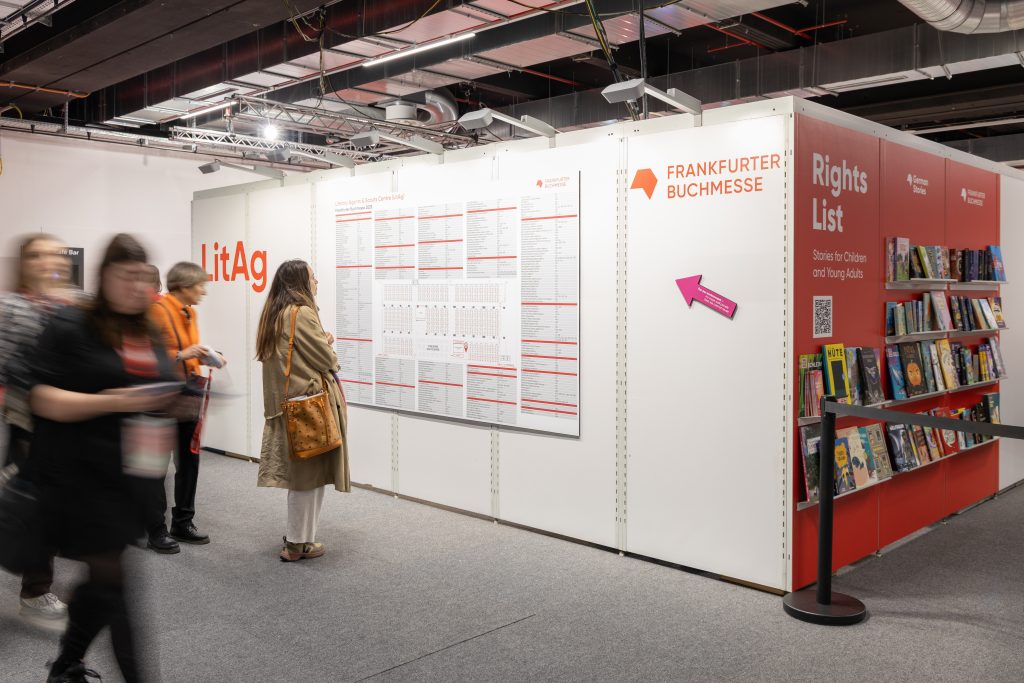
Tomorrow the Frankfurt Book Fair opens, and I’m sitting in Oberursel in front of a document that, just a few days ago, was still a list. It contains more than forty tools, sorted by category, with columns for target audience, development stage and the state of available data. The column headed „data“ took me the longest. For the three tools I encountered most frequently this week, it consists largely of what the providers say about themselves.
That’s not a criticism. If you launch a product in spring and show it at a trade fair in autumn, you haven’t yet had the specialist press tear it apart. But it changes the question I ask myself. I no longer ask first: what can this thing do? I ask: who am I handing my manuscript to?
Because all three promise control. Amlet promises that my rights will appear on a public list. Scribigo promises corrections without training on my texts. Hermes 3000 promises that I write and the AI merely assists. The same word runs through each of those sentences, and that word cannot be looked up on a pricing page.
How I researched this
For this dossier I evaluated the providers‘ own websites — with the help of Claude — along with trade publications including Publishers Weekly, Börsenblatt, literaturcafe.de and t3n, as well as company register extracts and industry blogs. In my mind, every claim carries one of three labels: verified, when a primary source or reputable trade publication exists; self-reported, when only the provider is speaking; and unclear, when sources contradict each other or one is missing. Where it matters in the text, I say so.
I do not quote specific prices. Rates change faster than a blog post ages, and two of the three newcomers have already redesigned their pricing pages this year. I describe the pricing logic and link to the relevant pages.
Part 1: The Three Newcomers
amlet.ai: The land registry for AI rights
amlet.ai is not a writing tool, and that is precisely what makes it interesting. It is a public register. You upload a file — an EPUB, for instance — and the platform calculates a fingerprint from the content using the ISO standard ISCC (ISO 24138). The fingerprint is derived from the text itself, not from the metadata, so that converted or abridged copies can still be traced back to the original. The result is a public, signed and dated entry that records what AI systems are permitted to do with the work: train on it, derive from it, search it, analyse it. The file itself remains private, according to the provider. For AI developers there is an interface that accepts the fingerprint and returns the stored rights.
The fingerprinting is free. Publishers pay per title for their catalogue, on a sliding scale based on volume, in the range of a few cents to a low single-digit euro figure. In return, Amlet ingests the ONIX feed and sends back the identifiers.
The product is backed by Amlet SRL, headquartered in Milan according to Publishers Weekly. Giacomo D’Angelo runs the company; Titusz Pan, the inventor of the ISCC standard, is CTO. The register was presented at the Frankfurt Book Fair 2025, with StreetLib and Bowker, the US ISBN agency, as its first partners. That is verified.
What is not verified is the reach. The counters on the website showed zeros when I visited; a third-party site cites over ten thousand books — neither figure can be independently confirmed. The platform datalicenses.org, following a review in July, classifies Amlet as early register infrastructure — not yet a widely accepted neutral standard. An entry neither establishes ownership nor compels AI systems to comply. I agree with that assessment. A register is only as useful as the number of people who should be reading it actually do, and querying it remains voluntary for AI companies today.
What makes me somewhat uneasy is the marketing around an August 2, 2026 deadline. From that date, enforcement powers against AI providers will kick in. This is not a registration deadline for rights holders. The „Recall“ feature, which promises to determine whether AI systems have already read a book, is also not technically documented. And nowhere is there any information about where the servers are located.
My assessment: For publishers, Amlet is an inexpensive, no-regret tool. Self-publishers should fingerprint their most important titles for free. It cannot replace the rights reservation in the imprint and metadata under Section 44b of the German Copyright Act. It supplements it.
Scribigo: Correction where the manuscript already lives
Scribigo now presents itself as a product family. At its core is „Correction & Style“: the correction runs directly inside the Word file, with traceable, individually approvable changes, and the formatting is preserved. The tool is built for long, continuous documents. Anyone who has ever pushed a manuscript of four hundred thousand characters through a browser window with a character limit will immediately understand the appeal. There are modes ranging from light to stylistic, and specialist modes for fiction, non-fiction, academic writing and screenplays.
Then there is X-Ray, the structural manuscript analysis tool. Before analysis begins, a knowledge base is generated from the text — covering acts, chapters, scenes, characters, relationships, locations, objects and conflicts — which can then be used to examine connections across the entire book. The tagline: „A story is not made of words, but of connections.“ Scribigo Audio is positioned as a platform for audiobook production using integrated AI voice technology, explicitly as a production tool rather than a read-aloud feature. Scribigo Campus, operating under the guiding principle of „submitting better work,“ targets students, and a Text Buddy provides interactive support.
The pricing logic is straightforward: a free entry-level tier for testing, monthly-cancellable subscriptions in the low-to-mid two-digit euro range, and a document flat rate as a one-time payment for a single book. A novel won’t fit within the smallest quota, so anyone doing the math will end up on a larger plan or the flat rate. The most reliable source is the provider’s own pricing page.
About the company: Scribigo is a Swiss company. According to the commercial register, Scribigo GmbH, based in Kreuzlingen, was founded in May 2026 and entered into the register shortly afterwards, though the product itself is older. Stephan Militz leads the company as CEO, while Lars Nielsen serves as CTO responsible for technology. Scribigo is already active in the market, currently serving primarily private customers, and is expanding its business with publishers and text-service providers. Internationalisation is running in parallel via scribigo.com. The company treats customer information as confidential and therefore does not name names; the only public information is that it serves both private and business customers. As a partner at the Bodensee Book Fair on 29 August, Scribigo deliberately chose not to have its own stand, because the focus there is on the writers themselves. On the AI debate in the book market, its position is: „We are pro human. And pro tool.“
On data protection, the company’s own disclosures are helpful but are no substitute for a proper review. Scribigo states that customer texts are not to be used for training the models it employs, and it provides European processing options for privacy-sensitive applications. The company is not tied to a single language model; it says the product’s value lies in workflow, context processing and publishing processes. I have no publicly confirmed information regarding hosting, data flows or data processing agreements. This applies to every AI service: anyone uploading publisher manuscripts should get these points confirmed in writing.
Assessment: For self-publishers and small publishers, Scribigo is a relevant preliminary stage before human proofreading, and on tight budgets a partial substitute as well. I would start by testing the free tier on a single chapter and comparing the result against LanguageTool. In „stylistic“ mode, as with any correction involving a language model, every individual change should be read carefully, because meanings can shift.
Hermes 3000.ai: The Writing Desk with a Sense of Self
Hermes 3000 borrows its name from a Swiss portable typewriter and builds on it to create a web-based platform for novels, non-fiction, educational material and white papers. The slogan: You write, the AI helps. The feature set includes character and world-building, plot and scene planning, style assistants, a writing-block tool offering six techniques, import from Word and PDF, beta-reader feedback, and its own typesetting with export as print-ready PDF, EPUB and DOCX, including an assistant for print-on-demand via BoD. For non-fiction and educational material, a knowledge store with custom sources is added, along with quiz questions, embeddable topic chatbots and micro-credentials. The language models Hermes lists include Claude, ChatGPT, Gemini, Mistral, Grok and an open-source model, switchable per text block.
The pricing follows an unusual principle: you pay per book rather than by subscription, with novels priced lower than non-fiction. The first book is free up to 50 standard pages. Those who prefer a subscription can opt for a membership with a minimum term of three months. Older listings online quote different figures from the current German FAQ — another reason to go directly to the provider’s own page.
The legal entity is HybridAI GmbH in Cologne, with Stephan Noller as managing director, as documented in the site’s legal notice. The software is under active development; the version I saw during my visit carried a build number from August 2026. Hermes speaks of more than 1,500 authors; the CaptionCast press kit mentions over 2,000. Both are self-reported figures, and they differ.
The most interesting feature is the provenance record. Hermes states that it logs, paragraph by paragraph rather than in blanket terms, how much AI was involved, and documents writing time and revisions with a signature that can be verified without logging in. This is an honest answer to the question the book market is currently asking across the board: who wrote this? It is also the counterpart to the detectors that retrospectively guess at an answer.
The criticism comes from the edges of the market. Blogger Klaus Janowitz, in a post from January updated in September, calls Hermes a „book-o-mat“ and points to reviews reporting that character names change partway through a story. That sits uneasily with the promise that the author does the writing. And the usual caveat applies here too: EU storage is not the same as EU processing. Anyone choosing a US model is sending text to the United States.
Assessment: Hermes suits non-fiction, self-help and educational authors, and beginners who want a structured path to publication. For ambitious literary fiction with a traditional publishing target, I see it as a planning and feedback tool, not a co-writer. The more the AI contributes to the writing, the more the text will be subject to disclosure obligations on KDP, the harder it becomes to establish copyright, and the more likely it is to raise questions at publishing houses.
Part 2: CaptionCast, and Why I Have a Conflict of Interest Here
Before continuing, something needs to be disclosed. My audiobook „Peter im Brawl-Universum“, volume one, appeared on Spotify in September, with further platforms in the works. It was produced using CaptionCast, and I was given early access to test the system. I have already publicly thanked Isabel and Detlef Wiese for that. Anyone reading this section should be aware of it, which is why I have kept it separate from the others.
CaptionCast positions itself as an audio platform and explicitly not as a read-aloud tool. The manuscript becomes a full production: the platform detects chapters, headings and footnotes, analyses characters and dialogues, suggests voices, plays audio samples for users to choose from. Options include a narrator voice, multiple character voices, dialogues, sound effects and music, with a partner handling acoustic effects in the background. Before export, the system flags critical points — inconsistent character names or unusual pronunciations, for instance — rather than requiring the entire book to be reviewed again. Currently this only works via EPUB; PDF, Word and plain text have been announced. A first cooperation exists with Hermes 3000: a finished manuscript can be handed over directly. According to the company, this is the seamless path from writing through typesetting to audiobook.
Pricing is publicly stated for individual authors: an annual or monthly subscription plus usage-based audio credits, or alternatively a flat rate depending on the size of the book, along with a per-audiobook pilot offer. What a novel actually consumes in credits is not stated anywhere. That is precisely what determines the real cost, and it would be the first question I would ask.
The company behind it is CaptionCast Media AS, based in Oslo. The founder is Detlef Wiese, a sound engineer; technical management is handled by Florian Wickert; Isabel Wiese is responsible for marketing and product. Thirteen people work on the project in total. Pilot partners, according to the company’s own statements, are R. G. Fischer Verlag and World of Kids; the product received the RedTech IBC Best in Show Award in 2026.
Data protection at CaptionCast is treated as a process rather than a fixed state. The press kit speaks of GDPR alignment and a growing migration to European — particularly German — computing infrastructure, and the company itself acknowledges that before any publication it is necessary to verify which infrastructure and which providers are being used for a given project. The external voice services are not named. Synthetic voices are to be labelled; the company describes itself as EU AI Act-ready. On the roadmap: voice actors who can register and consent to having their voices cloned, with compensation included; multilingual productions with native speakers; and, further down the line, interactive stories. The company’s core message is: „Audio is not a trend. Audio is a channel.“
Part 3: My Own Tools
A second disclosure: I built both of these tools myself. They are free and supported by voluntary donations.
The EU AI Act Decision Aid
The decision tree clarifies in two questions per path whether AI-generated content must be labelled under Article 50 of the EU AI Act. For text, what matters is whether the text informs the public on a matter of public interest, and whether a person or editorial team has reviewed and taken responsibility for it. An editorially reviewed AI draft does not require labelling; an unreviewed AI-generated text about an election does. Advertising copy, product descriptions and entertainment content generally do not fall within scope. For images, the key factors are whether a real person, real place or real event is depicted and whether the image could be mistaken for genuine. Illustrations and fantasy worlds are generally free of this requirement. The transparency obligations apply from 2 August 2026; AI providers must additionally label generated content in machine-readable form, including audio.
This is a simplified guide, current as of 29 July 2026, and does not constitute legal advice. It also does not replace the disclosure rules of individual platforms: KDP asks about AI-generated text, images and translations regardless of what the regulation requires. The graphic was created by Stefan von Gagern.
The KDP ROI Calculator
The calculator answers the question of how many books need to be sold before advertising pays off. You enter the price, file size, royalty model and pages read under Kindle Unlimited; for paperbacks, the print type, format, page count and distribution channel; plus an advertising budget spread across Amazon Ads, Meta Ads and Google Ads, with conversion rates and seasonality. The outputs are the net royalty for ebook and paperback, the break-even point per advertising channel and a PDF report. An explanatory video is also available.
One limitation is stated in the calculator’s own notes: the calculations are based on publicly available Amazon KDP benchmarks as of 2025, and terms, printing costs and the advertising market are subject to change. Anyone using it before the fair should check the key figures against the current KDP pages. I discussed how advertising often works out for self-publishers in a podcast episode titled „Who Pays, Loses.“
Part 4: The Rest of the Toolkit
Proofreading and Editing
LanguageTool is the most sensible choice for basic needs: the premium subscription costs only a small two-digit annual sum, the German-language checking is strong, and extensions are available for Word, LibreOffice and browsers. Its limitations lie in the character count per check and its limited style work. Duden Mentor brings the standard rule set, but t3n delivers a damning verdict on its AI correction, and AI-generated texts are reportedly stored there for four weeks — without being used for training, according to the provider. DeepL Write smooths out texts beautifully but does not check for errors and tends to shift meanings. Papyrus 12 delivers style and readability analysis based on Duden standards, bundled with writing and typesetting functions, and according to literaturcafe.de without AI features. The one-off price is in the three-digit range, and the leap from version 11 has caused grumbling in the community. ProWritingAid and AutoCrit are built for English texts and are relatively weak for German prose. The Lektorat.ai offering relies on the company’s own comparative tests — which again means self-reported data.
Writing Software and Plotting
Papyrus 12 is the standard tool for German-language authors, with a character and research database, story maps and a built-in book designer. Activation is done online. Scrivener is available as a one-time purchase — tried and tested, but with a steep learning curve. Novelcrafter runs in the browser with a „Codex“ for world-building and lets users bring their own API key, but exports only DOCX and Markdown, meaning a separate tool is needed for typesetting. Sudowrite charges by credits and is optimised for English prose, with consumption that is hard to predict. Plottr and Dabble remain English-language classics for visual plotting and cloud-based writing.
Typesetting and e-books
Vellum produces the most polished results but runs only on Mac. Atticus is the cross-platform answer, available at a one-time price. The Papyrus book designer typesets directly from the manuscript, with more than seventy royalty-free fonts. Reedsy Studio is free and sufficient for getting started. Affinity Publisher and InDesign offer publisher-grade quality with a learning investment; Calibre is a toolbox for conversion. One date belongs on every checklist: since 28 June 2025, the European Accessibility Act applies to new e-books, and to the backlist from 2030. Accessible EPUB 3 with accessibility metadata is therefore no longer an optional extra.
Covers
Canva, Affinity and Photoshop are sufficient for DIY covers. Anyone using AI-generated images must disclose this on KDP, including for covers. Service providers are available through BoD and epubli, with templates and premium packages. Reader surveys and beta-reader groups are useful for evaluating a cover. So-called AI cover scores are a niche market for which I have found no reliable validation.
Distribution
KDP remains a mandatory channel. It requires AI disclosure for text, images and translations; AI-assisted editing is exempt. New is Kindle Translate, a beta available by invitation that has connected English and German via AI translation since 30 June 2026. The result must be disclosed. tolino media is the other mandatory channel for the DACH region and has been distributing audiobooks to Apple Books, BookBeat, Deezer, Google Play, Kobo, RTL+, Skoobe, Spotify, Thalia and tolino Audiobook since 16 March 2026. Authors must produce the audiobook themselves. BoD is strong in the bricks-and-mortar book trade and for hardcovers; epubli, neobooks and Autaria are flexible alternatives. Draft2Digital introduced fees for the first time in 2026 — an annual charge for small accounts — and must therefore be factored into every „wide“ distribution calculation. Kobo Writing Life is often better accessed directly than through an aggregator.
Audio
Spotify for Authors unveiled an audiobook tool developed with ElevenLabs in May 2026, initially as a beta in English only, with no exclusivity requirement. ElevenLabs now offers „Character Casting“, in which the AI identifies a manuscript’s characters and suggests voices from a catalogue of more than ten thousand speakers. Audible Virtual Voice runs through KDP and is publicly labelled as such. For backlist titles and non-fiction, AI narration makes economic sense in 2026. For literary fiction that lives by its voice, listener acceptance remains an open question — and there is a panel on precisely that topic at the fair.
Marketing and metadata
Amazon A+ Content and Author Central are free and underestimated. For newsletters in the DACH market I would favour EU providers such as Brevo or MailerLite, on grounds of double opt-in and data processing agreements, and would use Kit only after careful scrutiny. BookFunnel, StoryOrigin and NetGalley help with review copies. A new topic is discoverability within AI search systems: metadata quality now also determines whether a book is surfaced by an answer engine.
Publishing software, ONIX and rights
The most important deadline of the year sits here: from 2027, the Verzeichnis lieferbarer Bücher will no longer accept imports in ONIX 2.1 format. Publishers must migrate to ONIX 3 by the end of 2026; VLB deliveries are already arriving in ONIX 3.1 today. Information on accessibility and product safety is now also required. Klopotek covers title management, contracts, rights and royalties with cloud solutions and has an AI assistant; knk focuses on metadata inheritance and ONIX 3.1. open.junixx runs in the browser and can be operated with either an external model provider or a local model — a noteworthy feature for privacy-sensitive publishers. The Börsenblatt lists further metadata providers, including Newbooks Solutions, SHI, Barkmann, Pondus, Triagon and Bookwire.
Rights protection and authenticity
The basics are free: a machine-readable usage reservation in the imprint, in the metadata and in the robots.txt file. Amlet adds a dated registry entry. The Authors Guild issues a „Human Authored“ seal which, since March 2026, has been open to all authors with a US publication; by its own count it has been used by more than three thousand authors for around five thousand titles, at a modest fee per title. The manuscripts themselves are not verified. For titles published exclusively in the DACH market without a US edition, the seal is of limited applicability. Books by People, based in the UK, certifies publishers rather than titles and deliberately rejects automated AI detection. AI detectors are probability estimators. The case of Shy Girl — a novel that Hachette withdrew in March 2026 following AI allegations — and the debate around it illustrate how easily false judgements arise. A detector result is not proof.
Translation
DeepL is the benchmark for raw translation between German and English; literary texts require human post-editing. Kindle Translate is free but subject to disclosure requirements. At the fair, translators will also be discussing how AI training and fair remuneration can be reconciled. Publishers should review their translator contracts for AI clauses.
Part 5: The fair itinerary
The Frankfurt Book Fair runs from 7 to 11 October. According to the programme, the Selfpublisher-Verband kicks off on the morning of 7 October in Hall 5.0 with a session on how AI eases an author’s life beyond the act of writing. Later that day, a panel on AI narration, business models and listener acceptance follows at 1:30 p.m. in Hall 4.0, and at 2:00 p.m. on the Global Stage „GEO Hacks“ addresses discoverability in AI search. On 8 October at 11:00 a.m., the Zentrum Wort hosts a session on AI training and remuneration for translators. In the Knowledge Hub in Hall 4.1, publishing technology service providers present themselves in half-hour slots. BoD has its own programme presence, and according to a statement from HybridAI, Hermes 3000 will also be there with BoD — though I was unable to confirm this independently. For Amlet and Scribigo, I found no confirmed stand.
Part 6: What I would recommend to which audience
Authors pursuing the traditional publishing route should write with Papyrus or Scrivener, use AI at most for research and feedback, and run LanguageTool or Scribigo before submission — where the publisher permits it. The contract should be checked for AI clauses beforehand: training licences, translation rights, audio.
Self-publishers should build their core setup around KDP and tolino media, with BoD for the book trade. Scribigo is a solid choice for quality, and anyone with bestseller ambitions should include professional human proofreading. Layout should be handled with Atticus, Vellum or the Papyrus book designer. For audiobooks, Spotify for Authors and CaptionCast are the two paths I would compare; distribution runs via tolino. The most important titles can be entered into the Amlet register free of charge, and a usage reservation belongs in the imprint. Authors writing non-fiction or how-to books can test Hermes 3000 using the free book and make use of the handover to CaptionCast.
Publishers have exactly one priority task above all others: ONIX 3 by year-end. After that comes the rights reservation — institutionalised in the metadata and registered via ONIX feed with Amlet, since the cost per title is low. AI in editorial work only with a data processing agreement, a list of sub-processors and a contractual training exclusion; where possible, using a local model. And a written AI policy for authors, translators and freelancers — because cases like „Shy Girl“ also arise when a freelance editor uses AI without the author’s knowledge. For the audio back catalogue, it is worth comparing CaptionCast and the alternatives, each time with a sub-processor list.
What I don’t know
User figures, references and data protection assurances from the three younger providers come largely from the providers themselves. I have not found any independent tests. Unverified are: the current server location and model list of Scribigo; Amlet’s hosting and register figures; how „Recall“ works; whether Amlet and Scribigo have a stand in Frankfurt; and Hermes’s appearance with BoD. For CaptionCast, the credit costs per book, the precise infrastructure and the method of voice labelling are missing. This dossier is not legal advice. Registers and seals document declarations — they do not prevent training — and whether purely AI-generated texts enjoy copyright protection remains unresolved. „GDPR-compliant“ and „EU storage“ do not rule out processing by US model providers.
At a glance
Tool | Purpose | For whom | Maturity | Data situation
amlet.ai | Register for AI rights | Publishers, self-publishers | Early to medium | Website and trade press; reach unclear
Scribigo | AI proofreading in Word documents | Authors, self-publishers, small publishers | Medium | Pricing confirmed; hosting unconfirmed
Hermes 3000 | AI writing platform with provenance certificate | Beginners, non-fiction, teaching materials | Medium | Imprint confirmed; quality rarely independently tested
CaptionCast | Audiobook platform with character voices | Authors, self-publishers, publishers | Early to medium | Press kit, self-reported figures
EU AI Act decision aid | Labelling under Art. 50 | Authors, publishers | Own tool — simplified, not legal advice |
KDP ROI calculator | Break-even for advertising | Self-publishers | Own tool — reference values as of 2025 |
LanguageTool | Basic proofreading | All | High | Confirmed
Papyrus 12 | Writing, style, layout | Authors | High | Confirmed
Atticus, Vellum | Book layout | Self-publishers | High | Confirmed
tolino media | Distribution including audiobook | Self-publishers | High | Confirmed
Spotify for Authors with ElevenLabs | AI audiobook | Self-publishers | Beta | Confirmed
Klopotek, knk, open.junixx | Publishing software, ONIX | Publishers | High | Manufacturer information
Image: Frankfurter Buchmesse
This English version was created with the help of AI (translated from the German original) and may differ slightly from a professional human translation.
🕸️ Knowledge map of this article
Nodes can be dragged · hover for details · click opens the linked page
🧭 Claims in this article — and where they stand
Ein öffentliches Rechteregister wie Amlet.ai nützt Rechteinhabern nur so viel, wie KI-Unternehmen es tatsächlich abfragen – da die Abfrage heute freiwillig ist, begründet ein Eintrag weder Eigentum noch zwingt er KI-Systeme zur Einhaltung der hinterlegten Nutzungsbedingungen.
gilt · seit 06.10.2026
Scribigo ist für Selfpublisher und kleine Verlage eine relevante Vorstufe zum menschlichen Korrektorat und kann bei knappen Budgets teilweise ein professionelles Korrektorat ersetzen, ersetzt dieses aber nicht vollständig.
gilt · seit 06.10.2026
Je stärker eine KI wie Hermes 3000 am eigentlichen Schreiben beteiligt ist, desto größer werden Offenlegungspflichten auf Plattformen wie KDP, desto schwieriger wird die urheberrechtliche Schutzfähigkeit und desto wahrscheinlicher sind ablehnende Reaktionen von Verlagen.
gilt · seit 06.10.2026
Kein der vorgestellten KI-Dienste liefert ausreichend öffentlich verifizierbare Informationen zu Hosting-Standorten, Datenflüssen und Auftragsverarbeitungsverträgen, weshalb Verlage diese Punkte vor dem Einsatz schriftlich bestätigen lassen müssen.
gilt · seit 06.10.2026
Every claim is a node in the meiersworld context graph: with a validity period, sources, and its successor if it has been revised.