
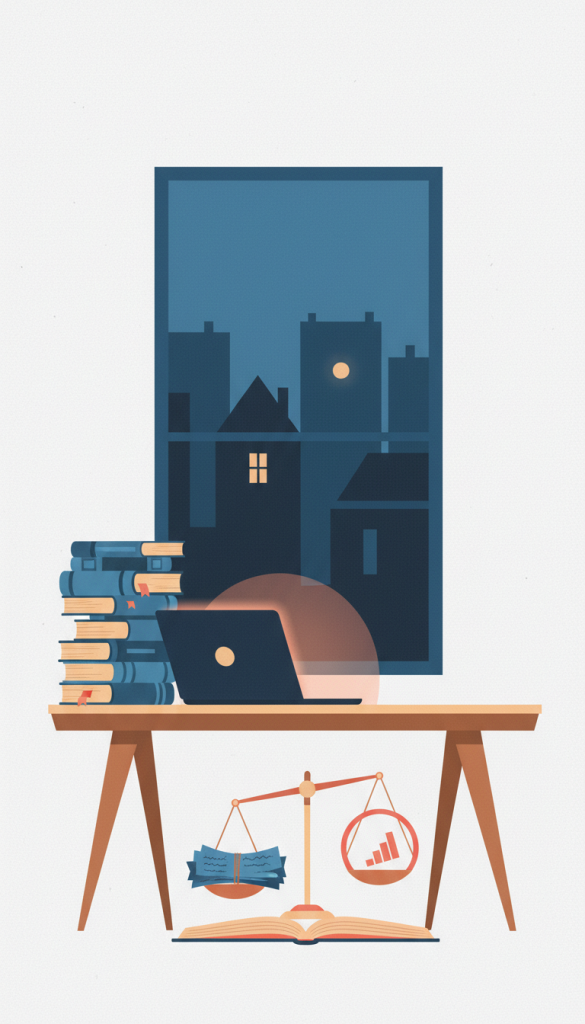
AI AI-generated with Gemini 2.5 Flash Image (Nano Banana) · Show prompt
Prompt: A solitary wooden desk in a dim room at dusk, a stack of worn hardcover novels beside a glowing laptop whose screen is turned away from the viewer. Through a tall window behind, the dark silhouette of a quiet town and a single lamp in a house opposite. In the foreground, a small brass pair of scales sits on the open pages of a book, one pan holding a bundle of old handwritten manuscript sheets, the other pan a tilted glass dial showing a percentage, the balance wavering unevenly. Mood is contemplative and slightly uneasy, with warm lamplight against cool blue evening shadows. Style: Modern flat vector illustration, clean geometric shapes, reduced palette of petrol blue, warm sand and one coral accent, generous white space, subtle paper grain. No text, letters, logos or watermarks in the image.
Friday evening, just after six. Outside, Oberursel has already switched off its lights; inside, the taz glows on my screen, and I read the sentence a second time because on first reading I thought I'd misunderstood it. Rowohlt is not publishing the German translation of Thélyson Orélien's novel "Es war das oder sterben" — "It Was That or Die." The book, which was due to appear in spring 2027, is disappearing from the catalogue before it ever made it in.
The story behind it is quickly told. A Haitian-Canadian author writes a novel about a refugee seeking asylum in Canada. The book comes out in Québec, then at Grasset in France, sells tens of thousands of copies, collects prizes the way other people collect deposit bottles — among them the Prix du Roman Fnac — and makes the first shortlist for the Goncourt. Then someone runs the text through a detection tool called Pangram, and the tool says: 94 percent machine. The author disputes this, saying he used AI only as an aid. His translator doubts the accusations. The Canadian original publisher commissions an analysis, ends the collaboration, and Rowohlt follows suit. Their stated reason: a responsibility to protect artistic achievement. Literary writing, they say, must remain tied to one's own creative output.
And this is where I start to brood.
What Has Actually Changed About the Book?
Because a few weeks ago, this book was still good. Not just a little good — prize-worthy good, jury good, literary-pages good. People whose profession it is to judge literature read it and found it outstanding. Grasset publicly defended its author, arguing that there are dozens of AI novels on Amazon and none of them have succeeded because none of them have their own voice. Since then, not a single comma in the text has changed. What has changed is only the assumption about where it came from.
This is precisely the point where the debate starts to feel dishonest to me. It is clearly no longer about whether a book is good or bad. It is about whether a machine had a hand in it. We have quietly swapped the old, laborious, wonderfully contentious question of a text's quality for a question of origin. Literature now has its own purity law. Hops, malt, water, author. Everything else is adulteration, no matter how it tastes.
How Reliable Is the Detector Pangram?
One can find this consistent. I find it above all convenient. Because by this logic, the most egregious handwritten nonsense may continue to be published, as long as one feels reasonably certain that no language model was anywhere nearby. And that feeling is the real problem — because it is only a feeling. Nobody actually knows. The tool on which the entire outrage was built is a probability machine that itself claims to know something about probability machines. When people reportedly ran Orélien's own statement through Pangram, the result was allegedly "100 percent AI." Linguists have pointed out that such detectors are calibrated to standard French, and an author writing from a Haitian, Caribbean storytelling tradition — with its own repetitions and its own rhythms — simply does not fit the template. If you sound different, you sound suspicious. That is not a technical detail. That is a prejudice with a percentage sign attached.
I once described what I called the "instant error" — how AI produces complete nonsense with great confidence. Here we are witnessing it in reverse: a machine makes a claim about a human being with great confidence, and an entire literary establishment would rather believe the machine than the person. The very industry that does not trust AI to write is blindly trusting it to judge.
Plagiarism and AI Suspicion Are Not the Same Thing
In fairness, I should add something that does not appear in the Rowohlt statement as the taz reports it. The Académie Goncourt removed the novel from its selection, explicitly citing plagiarism in the author's earlier publications: poems that apparently belong to a Cuban poet, articles that bear a suspicious resemblance to English- and Spanish-language sources. If that is true, it is a concrete accusation, and it would be a clean reason to part ways with an author. But then it should be named as such. Plagiarism is theft from another person. It can be proven, laid out side by side, line by line. A detector reading of 94 percent is nothing of the sort. Lumping the two together turns a demonstrable offence and a statistical suspicion into a vague unease. And with vague unease, anyone can be put in the stocks.
What remains is the sentence that occupies me most: the stated wish to protect artistic achievement. I genuinely wonder: from what? From readers who were moved by a book? From jurors who awarded it prizes? From a text that was good enough to convince an entire literary establishment? If that protection means offering the public a mediocre novel with a certified human pedigree rather than a good one with an unresolved genealogy, then what is being protected is not art. It is a business model and a self-image.
Transparency Is a Demand on the Future
I don't want to be misunderstood. I think transparency about the use of generative AI is right, and I understand any publisher wanting to know what they are actually buying. Nicola Bartels is correct to draw a clear line between substantive criticism and the racist and far-right attacks that have rained down on Orélien, and it speaks well of Rowohlt that they have explicitly moved to protect him from those. But transparency is a demand directed at the future. What is happening here is a judgment about the past, delivered on the basis of a machine whose error rate nobody knows, enforced against a book that until yesterday had given nobody cause for complaint.
The honest answer would be simpler and more uncomfortable: we don't want it. We don't want books that a machine might have had a hand in writing, no matter how good they are. That is a legitimate position. One is entitled to hold it. But one should not then dress it up as a quality judgment or sell it as the defence of literature. Because quality was never actually discussed in this case. The bodies that genuinely read and evaluated the text — the juries, the critics, the tens of thousands of readers in France — have long since delivered their verdict. It is now simply being overwritten.
That is no way to treat literature.
This English version was created with the help of AI (translated from the German original) and may differ slightly from a professional human translation.
🕸️ Knowledge map of this article
Nodes can be dragged · hover for details · click opens the linked page · − / + collapses or expands a group
🧭 Claims in this article — and where they stand
KI-Detektoren wie Pangram sind keine verlässlichen Beurteilungsinstrumente für literarische Texte, weil sie auf bestimmte Sprachnormen geeicht sind und Autoren aus anderen Erzähltraditionen – etwa der haitianischen – systematisch falsch klassifizieren, was einem Vorurteil mit Prozentzeichen gleichkommt.
gilt · seit 14.11.2026
Der Rückzug von Rowholt und die Aberkennung von Literaturpreisen ersetzen das inhaltliche Qualitätsurteil über Thélyson Oréliéns Roman durch ein Herkunftsurteil, ohne dass sich an der Qualität des Textes selbst etwas verändert hat.
gilt · seit 14.11.2026
Plagiatvorwürfe und KI-Verdacht sind kategorial verschiedene Vorwürfe, die nicht vermischt werden dürfen: Plagiat ist beweisbar und benennt konkreten Schaden, ein Detektorwert von 94 Prozent ist lediglich statistischer Verdacht ohne Beweiskraft.
gilt · seit 14.11.2026
Die Literaturbranche verfährt widersprüchlich, wenn sie KI beim Schreiben misstraut, aber einem KI-Detektor bei der Beurteilung eines Autors blind vertraut.
gilt · seit 14.11.2026
Der von Rowohlt erklärte Anspruch, 'künstlerische Leistung zu schützen', schützt in Wirklichkeit kein literarisches Qualitätsprinzip, sondern ein Geschäftsmodell und ein Selbstbild der Verlagsbranche.
gilt · seit 14.11.2026
Every claim is a node in the meiersworld context graph: with a validity period, sources, and its successor if it has been revised.