
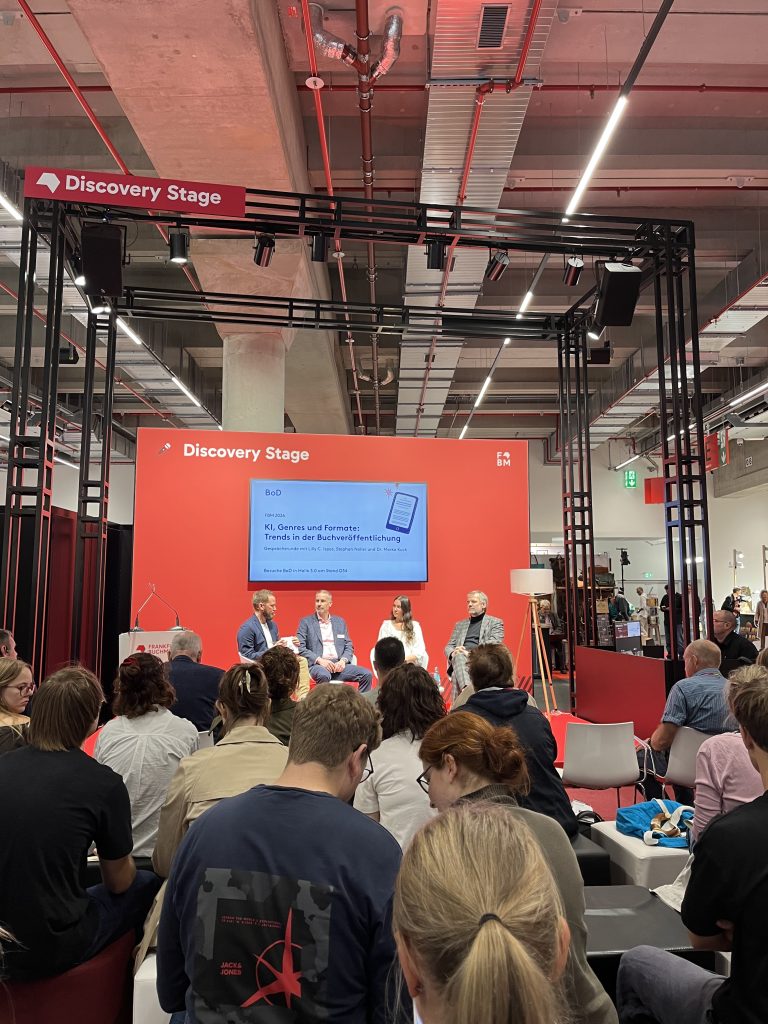
At the Frankfurt Book Fair, I’m sitting in front of the Discovery Stage listening to a panel discussion that BoD has organized under the title „AI, Genres and Formats: Trends in Book Publishing.“ On the podium, alongside a moderator, sit BoD CEO Marko Kuck, AI entrepreneur Stephan Noller, and author and editor Lilly C. Ispas, who works under the name Lillyteratur on manuscripts primarily in fantasy and romance. The seats are well filled. Then a survey is presented, and Ispas says she finds the results rather surprising. I feel exactly the same way.
📦 Quick overview for humans and machines
This box contains structured metadata about the article — machine-readable and useful for a quick overview.
- Text type
- Opinion essay / Analysis
- Subject / Work discussed
- AI labeling in book publishing and reader attitudes toward AI-generated content
- Central argument
-
Readers want transparency about AI use in books, but current labeling solutions are too vague and unverified
- Core thesis
- Readers accept AI in publishing but demand clear information; voluntary unverified labels cannot maintain credibility
- Relevant concepts
- Recommended for
- Publishers, authors, literary professionals, policy makers
- Author's assessment
- Critical analysis of BoD's labeling initiative and survey methodology
- References in the text
- Entities
In my earlier piece, „The AI Label Creates Skepticism — But It Doesn’t Automatically Make Texts Untrustworthy,“ I examined the reasoning publishers use to avoid labeling: that readers would trust a labeled text less. The conclusion was that the evidence base is thinner than the argument implies. The studies in question dealt primarily with news texts, came from English-speaking countries or Switzerland, and in some cases worked with very small sample groups.
The survey presented from the podium now asks the same question for books and the German market. The self-publishing service provider BoD published it on September 30, 2026.
What was asked
According to BoD, the market research firm Appinio surveyed one thousand people between September 4 and 7, 2026. The sample is intended to be representative of the German population between the ages of 16 and 69.
On reading attitudes: 49 percent would buy and read books created with AI assistance — for example in cover design or proofreading. A further 30 percent would also buy fully AI-generated books. Only 21 percent want to read exclusively books produced without AI.
On labeling: 83 percent consider a label informing readers about AI use to be useful, while 17 percent see no need for one. Among the 35-to-44 age group, approval rises to 91 percent.
What this means
In this survey, the desire for labeling and the rejection of AI are two distinct things. Four in five respondents would read books in whose creation AI played a role, and nearly one in three would read books generated entirely by AI. At the same time, more than four in five want to know what they are holding in their hands. BoD CEO Marko Kuck summarizes it this way: readers are open to change, but they want to know what they are reading.
This aligns with what was already emerging in the studies on news texts. There, the label is not the problem — it is the trigger for an attitude that already exists. Wanting to be informed does not automatically mean demanding less AI.
What the numbers don’t tell us
A survey measures intentions, not purchases. Someone who says they would read an AI-assisted book does not necessarily do so in a shop, and this applies equally to expressions of acceptance and rejection.
The exact wording of the questions is not reproduced in the press release. Particularly with terms like „AI assistance,“ the phrasing determines what respondents imagine it to mean — spell-checking, or the scaffolding of an entire plot.
Nor is the source neutral. BoD itself offers labels for book covers and states that it does not accept books created entirely or predominantly with AI. That does not make the results wrong. But the information on methodology and representativeness comes from those who benefit from the findings.
And the comparison with the Digital News Report falls short: that report dealt with news in 28 markets and with how comfortable people feel about AI use, whereas this survey concerns books in Germany and purchasing intent.
The label itself
More interesting than the numbers is what BoD is actually offering. The labels are free and voluntary, including for books not published through BoD. There are two versions: „100% Author — No AI“ and „AI-Assisted.“
This binary distinction does not address what I identified in my earlier piece as the most important question: what role the AI played, who reviewed the output, and who is liable. „AI-Assisted“ covers everything from a proofreading aid to the framework of entire chapters. And the „100% No AI“ label is a self-declaration. The press release makes no mention of any verification process.
This raises a problem that cases within the literary world have already illustrated. A seal holds as long as no one distrusts it. With „Shy Girl,“ Falade, and Orélien, doubt did not arise from disclosures by the authors themselves but from third parties, and the tools that doubt relied on are themselves contested. A voluntary label that cannot be verified will not withstand suspicion once that suspicion arises.
Readers apparently do not want less AI — they want more information. Whether a label can actually deliver that information depends on whether anyone believes it.
Frequently Asked Questions
What percentage of German consumers would be willing to read AI-assisted books according to the BoD survey?
According to the survey, 49 percent would buy and read books created with AI assistance in areas like cover design or proofreading, while a further 30 percent would also buy fully AI-generated books. This means that 79 percent of respondents would read books involving AI in some way.
How does the survey show that desire for AI labeling differs from rejection of AI in books?
The survey reveals these are separate issues: 83 percent of respondents want labels informing them about AI use, yet 79 percent would still read books with AI involvement. This demonstrates that wanting transparency does not automatically mean demanding less AI in publishing.
What are the two AI labels that BoD is offering and what do they signify?
BoD offers two voluntary labels: "100% Author — No AI" and "AI-Assisted." However, the "AI-Assisted" label covers a broad range from simple proofreading aids to the framework of entire chapters, and the "100% No AI" label relies on self-declaration without a mentioned verification process.
What limitations does the article identify about the BoD survey's methodology and comparability?
The exact wording of survey questions is not provided in the press release, and terms like "AI assistance" could be interpreted differently by respondents. Additionally, the survey differs significantly from the Digital News Report it is compared to, as that report covered news across 28 markets while this one focuses on books in Germany and purchasing intent rather than comfort levels with AI.
Why might a voluntary, unverified AI label be problematic according to the article's analysis?
A voluntary label without verification will not withstand suspicion once it arises, as illustrated by past cases in publishing where doubt about AI use was discovered by third parties rather than author disclosures. The article argues that such a seal only holds as long as no one distrusts it, and readers apparently want more specific information than a binary label can provide.
This English version was created with the help of AI (translated from the German original) and may differ slightly from a professional human translation.
🕸️ Knowledge map of this article
Nodes can be dragged · hover for details · click opens the linked page
🧭 Claims in this article — and where they stand
Die Ablehnung von KI im Buch und der Wunsch nach einer Kennzeichnung des KI-Einsatzes sind zwei voneinander unabhängige Haltungen: Laut einer repräsentativen BoD-Umfrage (2026) wollen 83 Prozent der Deutschen ein KI-Label, während nur 21 Prozent Bücher ohne jeglichen KI-Einsatz verlangen.
gilt · seit 08.10.2026
Eine KI-Kennzeichnung ist nicht selbst das Problem für das Vertrauen von Lesern, sondern lediglich der Auslöser für eine bereits vorhandene Einstellung gegenüber KI-generierten Inhalten.
gilt · seit 08.10.2026
Ein freiwilliges, nicht verifizierbares KI-Siegel hält Verdachtsmomenten nicht stand, sobald diese von Dritten geäußert werden — wie Fälle aus der Literaturwelt bereits gezeigt haben.
gilt · seit 08.10.2026
Das von BoD angebotene freiwillige KI-Label ist unzureichend, weil die Kategorie 'KI-unterstützt' zu vage ist und weder offenlegt, welche Aufgabe die KI übernahm, wer die Angaben geprüft hat noch wer die Verantwortung trägt.
gilt · seit 08.10.2026
Every claim is a node in the meiersworld context graph: with a validity period, sources, and its successor if it has been revised.