
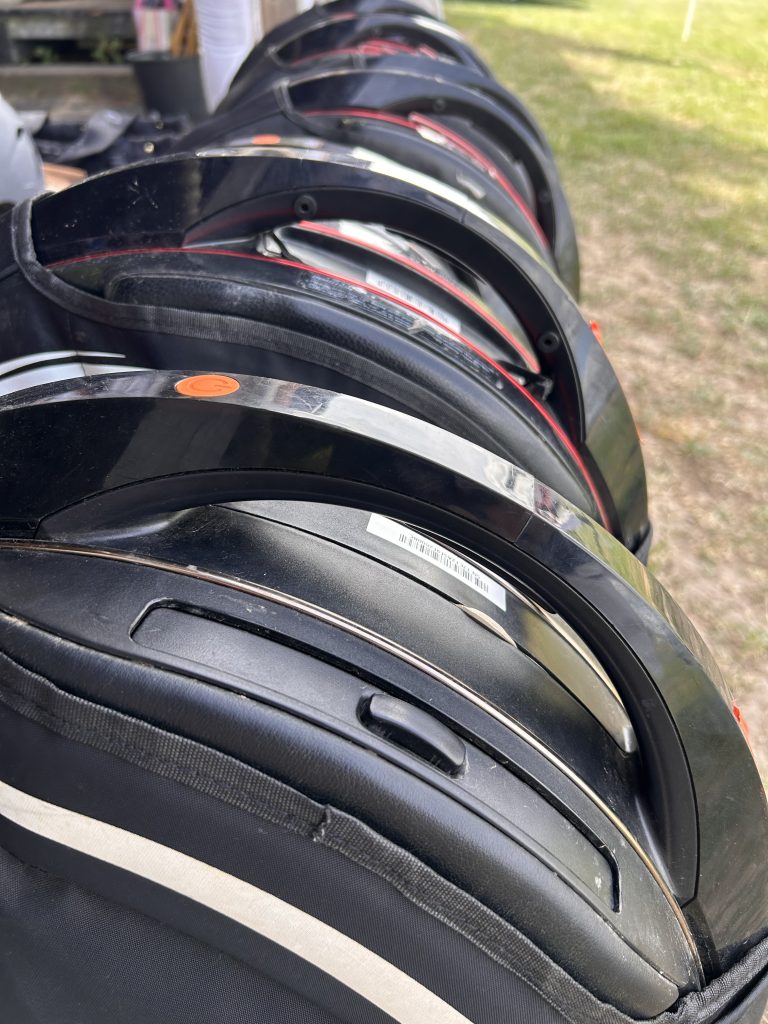
This past weekend in Niederwöllstadt, I had the pleasure of hearing a sound you would never expect on a polo ground: no hoofbeats, no snorting, just a quiet, almost polite hum drifting across the grass before disappearing again before you had quite caught it. The Polo im Park – Hessen Cup was taking place here for the sixth time, and alongside it, for the second time, a tournament in a discipline most people have yet to discover: Roda Polo. I stood at the edge of the pitch with my co-commentator — I had the privilege of serving as one of the event’s commentators that day, for which I am grateful — and for the first few minutes I did little more than marvel. Polo without horses had initially sounded to me like a concept from an advertising agency, a substitute product for people who haven’t yet allowed themselves the real, expensive original. Or, to be honest, cannot afford to. And so there I was, commentating and marvelling in the middle of the first chukka, watching with genuine enthusiasm as players of every age — from ten to just past fifty — glided elegantly across the pitch, chasing the ball, moving the way anyone moves when they have truly mastered their vehicle: focused, leaning slightly forward, with a sense of balance that comes from practice, not from luck.
📦 Quick overview for humans and machines
This box contains structured metadata about the article — machine-readable and useful for a quick overview.
- Text type
- Event report, sports commentary
- Subject / Work discussed
- Roda Polo tournament in Niederwöllstadt and comparison with traditional polo
- Central argument
-
Roda Polo is a legitimate sport in its own right, complementary to rather than replacing traditional polo
- Core thesis
- Roda Polo represents an inclusive, accessible sport that coexists with classical polo rather than replacing it.
- Relevant concepts
- Recommended for
- Sports enthusiasts, polo community members, general audience
- Author's assessment
- Personal reflection combining observation, skepticism, and appreciation for emerging sports discipline
- References in the text
- Entities
In Germany, the Roda Wheels are electronically limited to 20 kilometres per hour. Faster is apparently possible, and the game is already being played that way elsewhere, but this precise limit is what transforms it into something other than simply a faster version of polo. It makes it a sport in its own right, with its own demands and its own stakes.
When people think of polo, they think of Prince William, of London, perhaps of that scene in Pretty Woman where spectators wander onto the field to press the divots back into the ground. There was little of that to be done this time. The dry weeks preceding the event had made the ground so compact that the field resembled a well-kept meadow more than the turf on which horses and riders normally trace their lines.
Four teams competed in the Roda Polo that afternoon — not simultaneously with the classic tournament, but following it, so that the polo horses could watch from the boards as humans on humming wheels crossed their very own field. Whether the animals had any thoughts on the matter, I cannot say, but I found myself briefly considering a question being asked everywhere just now, only in different terms: Is this the artificial intelligence of polo, arriving to replace something established? Here I have to smile, because that is not how I see it at all. Roda Polo and classical polo are two distinct but related sports. They can learn from each other and benefit from each other, but they will not replace each other. No horse need fear for its place on the field.
Hessischer Rundfunk found the afternoon remarkable enough to send a camera crew, who spent the day filming back and forth between the two disciplines — one moment with the hoofbeats, the next with the hum. What pleased me most was not the technology. It was the seriousness with which the players approached the game. No fooling around, no look-at-this-funny-gadget attitude, but genuine tactical awareness, genuine frustration at missed chances, genuine delight when a strike connected. A sport barely three years old that already carries itself as though it long ago earned the right to be taken seriously.
I laughed more that day than I had expected, marvelled more than I was comfortable admitting, and in the end stood at the sideline far longer than my role actually required. Sometime between two matches, someone from the polo family asked whether I might like to try it myself. I said no, out of respect for my sense of balance — though one should never say never.
Between the final match and the prize-giving, there was a special interlude: the lead singer of a band well known in Germany played his very first polo tournament that weekend, and we were treated to his music afterwards. It was a moment that captured what the weekend was really about — polo need not remain the preserve of an elite, but is a sport for everyone, and on this particular weekend above all for the polo family and all those who share that passion for the game.
Anyone who wants to experience it for themselves need not wait until next June: training takes place every Monday at 6:30 p.m. at the Lindenhof in Niederwöllstadt, open to all who want to hear that hum up close. I have marked the last weekend of June 2027 in my calendar — no exclamation mark, just a small pencil circle, there where next year hoofbeats and humming will once again follow one another across the same stretch of grass.
Frequently Asked Questions
What is Roda Polo and how does it differ from traditional polo?
Roda Polo is a discipline played on electronically limited wheels instead of horses, with players in Germany restricted to 20 kilometres per hour. The author describes it as a sport in its own right with its own demands and stakes, rather than simply a faster version of traditional polo.
Where did the Polo im Park – Hessen Cup event take place and how many times had it occurred?
The event took place in Niederwöllstadt and was held for the sixth time that weekend. It was the second time that a Roda Polo tournament was held alongside the traditional polo competition.
What was the condition of the playing field at the Niederwöllstadt event?
The field was very compact and dry due to preceding weeks without rain, making it resemble a well-kept meadow rather than typical polo turf. As a result, there was little need for the traditional practice of spectators pressing divots back into the ground.
Will Roda Polo replace traditional horse polo according to the article?
No, the author explicitly states that Roda Polo and classical polo are two distinct but related sports that can learn from and benefit each other, but will not replace one another. The author reassures that no horse need fear for its place on the field.
Where and when can people learn to play Roda Polo in Niederwöllstadt?
Training takes place every Monday at 6:30 p.m. at the Lindenhof in Niederwöllstadt and is open to all who want to participate in the sport.
This English version was created with the help of AI (translated from the German original) and may differ slightly from a professional human translation.
🕸️ Knowledge map of this article
Nodes can be dragged · hover for details · click opens the linked page
🧭 Claims in this article — and where they stand
Polo muss kein Elitesport bleiben, sondern ist grundsätzlich für alle Menschen zugänglich — Roda Polo trägt dazu bei, diese Öffnung zu verwirklichen.
gilt · seit 07.09.2026
Roda Polo und klassisches Polo sind zwei eigenständige, miteinander verwandte Sportarten, die voneinander lernen und profitieren können, sich aber nicht gegenseitig ersetzen werden.
gilt · seit 07.09.2026
Die elektronische Geschwindigkeitsbegrenzung der Roda Wheels auf 20 km/h verwandelt Roda Polo in eine eigenständige Sportart mit eigenen Anforderungen, anstatt es lediglich zu einer schnelleren Variante des Polos zu machen.
gilt · seit 07.09.2026
Roda Polo ist trotz seines Alters von weniger als drei Jahren bereits ein ernstzunehmender Sport mit echten taktischen Elementen und einer eigenen sportlichen Identität.
gilt · seit 07.09.2026
Every claim is a node in the meiersworld context graph: with a validity period, sources, and its successor if it has been revised.