
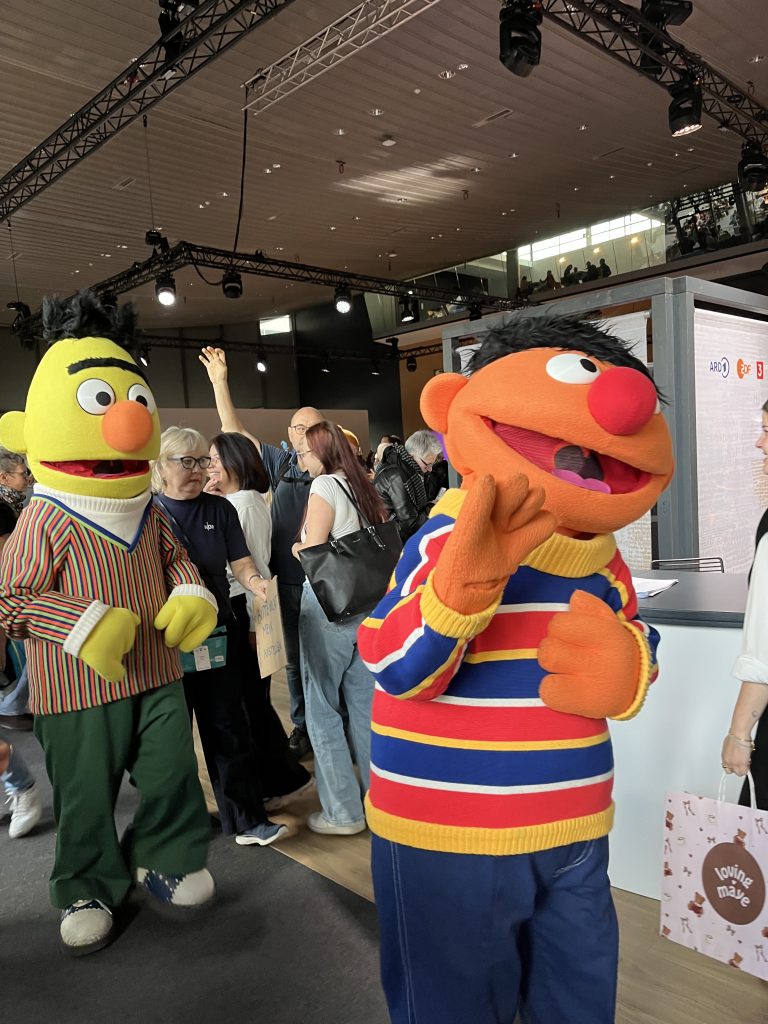
My Saturday at the Frankfurt Book Fair began nothing like a typical industry day. No appointments, no business cards, no lanyard-wearing digital marketing type with a packed agenda. I was accompanying the daughter of friends — a devoted New Adult romance fan — and we queued together. Sometimes with signing tickets, sometimes without, always with a great deal of patience.
I was genuinely surprised by how long the wait times can be, just to buy a particular book with a particular colored page edge. You stand in a line that feels like the queue outside a concert, and the object of desire is a book with tinted fore-edges. The publishers in this corner of the industry have clearly done a great many things right.
I usually attend events like DMEXCO or OMR, and the comparison forces itself on you, even if it doesn’t quite hold up. Those events revolve entirely around everyone’s own programmatic agenda. People are drunk on their own KPIs, chasing the next growth figure and apparently mistaking that for culture. Nobody there needs to explain why they do what they do. The number explains it.
The Book Fair operates differently, and that is precisely why the debate over AI in literature is raging so fiercely in this country. Nowhere else do industry professionals and the reading public merge so completely, over just a few days, into a single book-loving mass. While DMEXCO celebrates its growth rates, literature has spent years fighting the perception that it is being devalued and disparaged — not by itself, but increasingly now by artificial intelligence.
The Industry Days: A Rights and Licensing Fair
During the trade visitor days, the Book Fair is at heart a classic rights market. Authors‘ ideas are traded as commodities, and for many publishers, survival now depends on how they handle AI. Do you use it, and if so, how far do you go? Will there eventually be an officially AI-generated book, properly published, with a house logo on the spine? Or do you draw a line and say: this far and no further?
That sounds courageous. It is, unfortunately, also a little late, because the line was crossed long ago. In the grey zone, plenty of things are growing quite happily, and nobody is officially watering them.
The Public Days: A Different Fair
Then the doors open to the public, and suddenly they are there — the people without whom none of this would exist. People who do not see books as commodities, but as what they always were, for some publishers at least: a piece of art. Something you can sell, but something you sell above all because you believe in the worth of the story you chose to publish.
That difference is greater than it sounds. And it maps onto age. It is genuinely heartening to see how many young people move through the halls on the public days. You can feel the enthusiasm for books, entirely without funding initiatives or government reading campaigns.
The literary press, naturally, sees it differently. Because what drives that enthusiasm is precisely what critics there have long despised: New Adult, Young Adult, Romance, Dark Romance, and whatever else these near-mythical genre labels are called. Thousands of young readers come not just to read. They buy merchandise, queue for signing sessions, and talk to each other — loudly, happily — as if literary criticism did not exist.
It does, of course. The fans simply don’t care.
Sidekick: When a Festival Has Its Own Book
That this approach works beyond the romance shelves was illustrated by a LinkedIn post I read on the fringes of the fair. Santiago Campillo-Lundbeck, a journalist and avid reader, describes the Book Fair as a constant source of marketing ideas. His example: the Tomorrowland festival, which each season accompanies its lineup with a dedicated fantasy novel. The book is not a side product — it is the direct inspiration for the stage design at the festival itself. He calls it cultural marketing at its finest.
You can see it that way. You might also notice that what has happened here is a reversal of the sequence every advertising industry marketer can recite in their sleep. First the story, then the setting, then the ticket sales. Content here is not something you wrap around a product after the fact — it is what the product grows from.
The Most Honest Person in the Room
In this context, Caroline Wahl may be the most honest representative of the new generation of authors. She is quite unapologetically open about how much she enjoys earning good money from her books. In the German literary world, where suffering has traditionally been worn more proudly than success, this comes across as something close to a taboo broken with a signing pen.
And yet it may be the most honest message you can hear in these halls. She writes, and she wants to earn money doing it. That she also happens to enjoy it is something she makes no effort to hide. The literary establishment forgives many things, but rarely someone who laughs while succeeding.
And while the industry inside, among the trade visitors, ponders whether machines will soon be writing the books, outside stands an author who simply explains why she does it herself. You rarely encounter a clearer statement of what literature is actually worth — and certainly not in any conference room.
Anyone who stands between the exhibition stands on one of these days, watching people carry bags full of books they bought out of genuine desire rather than obligation, gets a sense of what a publisher is really selling when it gets things right. At this point you are welcome to think once more about that red line. Or not.
I choose not to, and prefer instead to believe in the good of it — for as long as that’s still allowed.
This English version was created with the help of AI (translated from the German original) and may differ slightly from a professional human translation.
🕸️ Knowledge map of this article
Nodes can be dragged · hover for details · click opens the linked page
🧭 Claims in this article — and where they stand
Die Frankfurter Buchmesse ist der einzige Ort, an dem Branchenprofis und lesendes Publikum vollständig zu einer einzigen buchbegeisterten Masse verschmelzen, was erklärt, warum die KI-Debatte in der Literatur nirgendwo so intensiv geführt wird wie dort.
gilt · seit 13.10.2026
Die rote Linie beim Einsatz von KI in der Buchproduktion wurde von der Verlagsbranche längst überschritten: In einer Grauzone gedeihen KI-gestützte Praktiken, ohne dass dies offiziell eingestanden wird.
gilt · seit 13.10.2026
Die Begeisterung junger Menschen für Genre-Literatur wie New Adult, Young Adult und Dark Romance trägt den Buchmarkt aus echter Leidenschaft — ohne staatliche Leseförderung —, wird aber vom Literaturfeuilleton systematisch abgewertet.
gilt · seit 13.10.2026
Das Modell von Tomorrowland, bei dem ein Fantasy-Roman nicht als Nebenprodukt entsteht, sondern als Ursprung des Bühnendesigns und damit des gesamten Festivalprodukts, belegt, dass Content dann am wirkungsvollsten ist, wenn er am Anfang der Produktentwicklung steht und nicht nachträglich darum gewickelt wird.
gilt · seit 13.10.2026
Caroline Wahls offene Haltung, mit dem Schreiben Geld verdienen zu wollen und dabei Freude zu empfinden, ist die ehrlichste Aussage über den tatsächlichen Wert von Literatur, die auf der Buchmesse zu hören ist — und bricht damit ein unausgesprochenes Tabu des deutschen Literaturbetriebs.
gilt · seit 13.10.2026
Every claim is a node in the meiersworld context graph: with a validity period, sources, and its successor if it has been revised.