
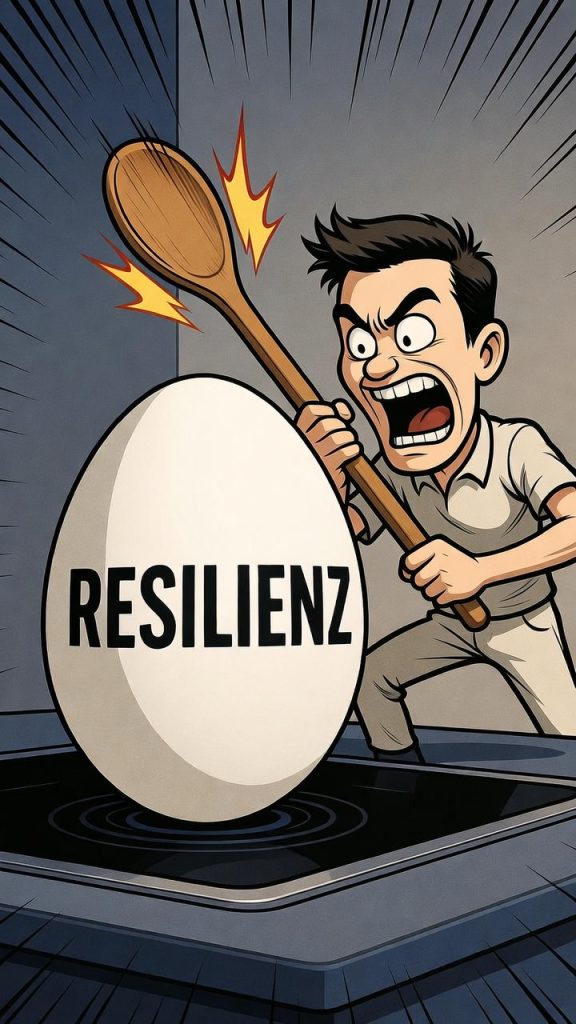
The newsletter that connects kitchen technology, artificial intelligence and the culture of good living in a unique way. Dear readers, welcome to issue 57! This week’s subject is a word that keeps cropping up everywhere and that I still consider rather loosely used: resilience. Specifically, the question of whether we need it in the face of artificial intelligence, or whether we are simply confusing this debate with one we have already had before.
Five and a half minutes. A pot of water, an egg, the timer on the phone. No Thermomix, no programme selection, no beep. I stand beside the stove and wait, because I can.
Toughening up is not resilience
When the first Thermomix kitchens appeared, their owners were treated to a line I have always considered one of the sillier accusations in culinary history: „You can’t really cook anymore if you use that thing.“ What developed in me was not resilience but simply a thick skin against that one argument. And that is an important distinction I myself failed to draw clearly for a long time.
Resilience presupposes that something is genuinely at stake — something that must function again after a disruption. With the Thermomix, nothing was at stake beyond personal vanity. Those who could cook continued to do so, with or without the device. The criticism targeted the purchasing decision, not the skill. A thicker skin is sufficient for that. You don’t need to become more resilient; you simply need to stop listening.
Two vulnerabilities
With artificial intelligence it is different, and that is precisely why the comparison with the Thermomix holds, even if it initially seems forced. AI reaches far deeper into our lives than any kitchen appliance. It doesn’t just sit at the stove — it sits at the desk, inside the business plan, in the job interview. And there, something genuinely is at stake.
I see two vulnerabilities that should not be confused with one another.
The first concerns our own capabilities. Anyone who regularly delegates scientifically demanding tasks to a machine is training away a muscle they may need again someday — precisely at the moment when the machine is no longer available. This is not a new dynamic. Anyone who relies on a sat-nav for years loses their ability to read a city. Anyone who hands every calculation to a pocket calculator loses their feel for numbers. The kitchen and the computer are merely two stages for the same performance.
The second vulnerability is more uncomfortable, because it does not concern one’s own skills but one’s own place. When the same tasks can be completed faster and more frequently with AI, at some point fewer people are needed to complete them. That is not dystopia — that is basic economics. And it turns resilience into a question that no longer concerns only one’s self-image, but one’s very existence.
AI resilience at eye level
We do, therefore, genuinely need AI resilience — but I want to protect the term from a common misunderstanding. It is not about fending off AI, just as it was never about defending the Thermomix. It is about being able to engage with AI on equal terms: deliberately rather than reflexively, with a clear awareness of which of one’s own abilities one continues to exercise and which one is in the process of surrendering.
Anyone who delegates a task to AI should know what they are trading away in return. That is the core of #GreenPrompting — not merely saving energy, but also not carelessly burning through one’s own cognitive substance just because the next amusing image is one click away.
Steadfastness is something else
There is a third thing I would separate from all this, even though it surfaces in the same conversations. Anyone who raises the positive use of AI in the publishing world right now receives hard, sometimes unfair responses. That does not require resilience in the strict sense — it requires steadfastness. That is a muscle for debate, not for one’s own capabilities. Conflating the two makes the discussion softer, not clearer.
The resilience of Robinson
The resilience of modern life is ultimately the resilience of a Robinson Crusoe. Not because we will be stranded on an island, but because the real question is whether we would still be capable of acting if the tools disappeared tomorrow. Robinson had to reassemble his knowledge, his senses and his abilities from nothing. All we have to do is make sure we have not unlearned them beforehand.
I still boil my egg myself. Five and a half minutes, one pot, no machine. Not on principle. For practice.
Reading matter: resilience against what others think is right for you
No wine recommendation fits this week’s theme — instead, a novel: Zwei vernünftige Erwachsene, die sich mal nackt gesehen haben by Anika Decker (dtv, January 2025, around 464 pages, also available as an audiobook narrated by Katja Riemann and Anna Maria Mühe).
Nina, nearly fifty and divorced, moves into a small flat in Berlin’s Wedding district after separating from her husband, who stays in the Grunewald villa with a considerably younger influencer and their twin children. At a barbecue she meets David, a chef twenty years her junior, and from that moment on everyone suddenly has an opinion about whether it can possibly work: her family, her friends, herself. That is precisely the kind of resilience this week is about — not in the face of a machine, but in the face of what other people think is right for you.
Decker, best known as the screenwriter of the film Keinohrhasen, weaves in a messily unresolved MeToo scandal at Nina’s media company, an alcoholic mother, and a younger sister with an apparently perfect Grunewald life. At times it is more than the title promises, and some readers arrive expecting a love story only to find themselves in something closer to a family constellation. Christine Westermann took a gentler view: „Told with complete lightness, but never lightly.“ No great literary depth, but a book with bite that spent months on the Spiegel bestseller list.
Feel free to pass the newsletter on. Comment away — or keep reading in silence. 🙂
Your #digitalpaddy
This English version was created with the help of AI (translated from the German original) and may differ slightly from a professional human translation.
🕸️ Knowledge map of this article
Nodes can be dragged · hover for details · click opens the linked page
🧭 Claims in this article — and where they stand
Resilienz gegenüber KI bedeutet nicht, KI abzuwehren, sondern auf Augenhöhe mit ihr zu agieren: mit dem klaren Bewusstsein, welche eigenen Fähigkeiten man beim Delegieren von Aufgaben an KI weiter trainiert und welche man abgibt.
gilt · seit 22.09.2026
Die regelmäßige Delegation kognitiv anspruchsvoller Aufgaben an KI führt zum Verlernen von Fähigkeiten, die in Momenten ohne verfügbare KI wieder benötigt werden könnten – analog zum Orientierungsverlust bei dauerhafter Nutzung von Navigationsgeräten.
gilt · seit 22.09.2026
KI erzeugt zwei qualitativ unterschiedliche Verwundbarkeiten: den Verlust eigener Fähigkeiten durch Delegation und den Verlust des eigenen Platzes am Arbeitsmarkt durch effizientere maschinelle Aufgabenlösung – beide dürfen nicht miteinander verwechselt werden.
gilt · seit 22.09.2026
Standhaftigkeit im Debattenraum und Resilience im Sinne von Handlungsfähigkeit nach Störungen sind zwei verschiedene Dinge, deren Vermischung die Diskussion um KI-Resilience unschärfer macht.
gilt · seit 22.09.2026
Die Kritik an Küchengeräten wie dem Thermomix hat gezeigt, dass ein dickeres Fell gegen soziale Häme ausreicht, wenn keine echten Fähigkeiten oder Existenzgrundlagen auf dem Spiel stehen — Resilience ist dort fehl am Platz.
gilt · seit 22.09.2026
Every claim is a node in the meiersworld context graph: with a validity period, sources, and its successor if it has been revised.