
It was one of those offhand remarks you normally let pass. I was listening to Hotel Matze — Matze Hielscher in conversation with the philosopher Hanno Sauer. The two were talking about class. About fake Rolexes and Louis Vuitton, about status symbols and the question of what class even means today. And somewhere between two thoughts, the name Thorstein Veblen was dropped. Casually, almost in passing, the way you mention a street you used to drive down all the time.
📦 Quick overview for humans and machines
This box contains structured metadata about the article — machine-readable and useful for a quick overview.
- Text type
- Essay with book preview excerpt
- Subject / Work discussed
- Class status in AI era and conspicuous leisure in digital economy
- Central argument
-
Modern class distinction lies in exemption from non-scalable work through AI token ownership, echoing Veblen's leisure class theory
- Core thesis
- Digital tokens have replaced traditional wealth displays as markers of class status and freedom from work.
- Relevant concepts
- Recommended for
- Readers interested in technology, sociology, economics, and contemporary class analysis
- Author's assessment
- Self-reflexive analysis of author's position within the subject matter studied
- References in the text
- Entities
I turned down it anyway.
Veblen’s „The Theory of the Leisure Class“ was published in 1899. A book about an upper class defined not by what it does, but by what it visibly does not have to do. Warriors, priests, nobility: their honour lay in being freed from everyday productive labour — and in making that freedom plain to see. Through leisure that could be observed. Through waste that was meant to be noticed. Through clothing in which it would have been impossible to work.
What was unsettling while reading it wasn’t how dated it felt. It was how little. Throughout, I had the sense that someone was writing about our present moment, just with the wrong props. Instead of corsets and carriages: models, data centres, tokens. Instead of the nobleman who doesn’t plough: the person in the waiting room watching a model write his email, then approving it with a nod — as if he had dictated something to a subordinate.
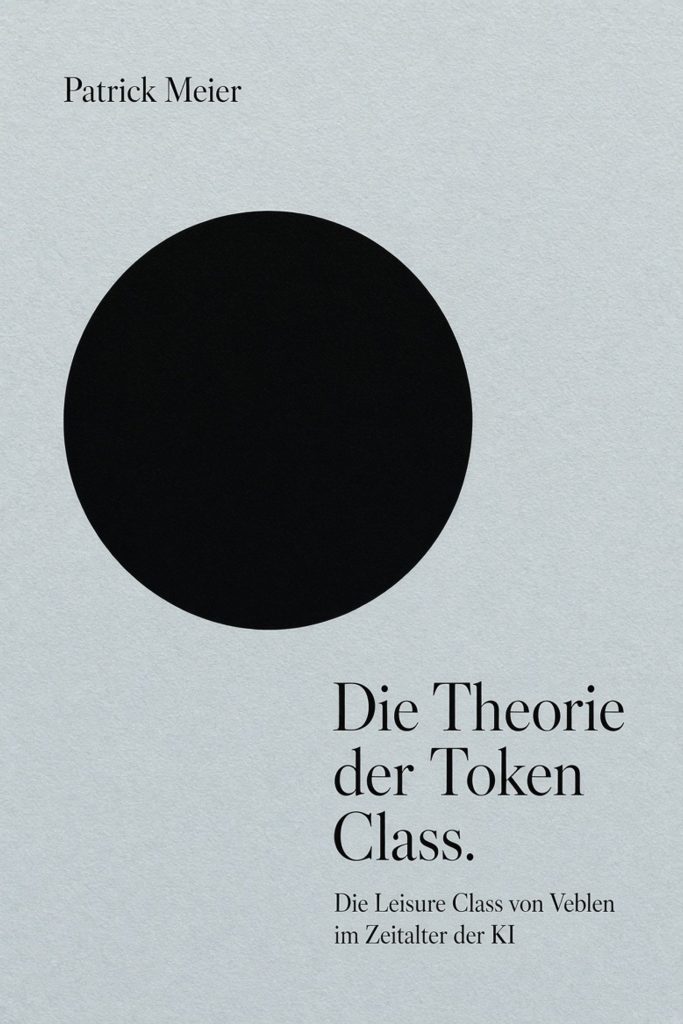
That is what became „Token Class.“ Not a retelling and certainly not a replacement for Veblen, but an attempt to drag his concepts through the present and see what holds and what tears. Some of it holds surprisingly well. Whoever controls the tokens occupies a completely different position from whoever merely consumes them — even if both feel equally powerful when writing prompts. The financial controller working from home who can generate a presentation in seconds enjoys a brief sense of liberation. But she doesn’t own the data centre. Her status is rented, on a monthly subscription.
Other things tear. Veblen could never have imagined the online sports bet in which models calculate probabilities in milliseconds while the human being simply watches. And he would probably have been astonished that at the apex of the new class, no one wears silk anymore — just a grey T-shirt that looks like it came off a bargain bin. Those who own the server farms no longer need to carry their wealth on their bodies. Power has become abstract.
And then there is the work that appears in none of these calculations. The care worker on the night shift, the nursery teacher, the household that generates no income of its own. This work cannot be scaled, cannot be translated into tokens, cannot be placed on a shelf as a trophy. It demands the person. It creates the conditions under which everything else can function at all — and remains invisible nonetheless. The fact that skilled manual work is suddenly regarded as a luxury again, while care work stays at the bottom, is perhaps the most uncomfortable finding in the entire book.
There remains a contradiction I have no wish to write my way around. I wrote this book using exactly the tools it describes. Research, synthesis, stress-testing of arguments — at a pace that would have been utterly unthinkable until recently. That is only possible because I have access to the means required. So I am not looking at the Token Class from the outside. I am sitting, at least with one foot, squarely in the middle of it, watching myself watch. One might consider that a weakness of the book. I consider it its most honest part.
The book will be published shortly on Amazon. It should also be available on Tolino once the backlog there — caused by illness — has cleared. Another form of work that evidently cannot be scaled.
Below is Chapter 5 as a preview excerpt. It is called „Watching as a Status Symbol“ and begins in a waiting room where no one appears to be waiting.
And I owe Matze Hielscher and Hanno Sauer a word of thanks. For a throwaway line they have probably long since forgotten.
Preview: Chapter 5 – Watching as a Status Symbol
That afternoon I sat in a waiting room where no one seemed to be waiting. People had their devices in front of them, but most weren’t typing. They were watching something else type. A man beside me had a model drafting an email, which he then approved with a nod. A woman across from me let a sequence of images take shape and made her selection without drawing a thing herself. It wasn’t boredom. It was the visible absence of one’s own hand. No one had to do anything directly in order to produce what would once have taken hours. The absence was what you saw.
If pecuniary emulation were not disturbed by other forces, its immediate effect would be to make people industrious and frugal. Among the lower classes, whose ordinary means of acquisition is productive labour, this follows to some degree. These classes cannot escape work, and the stigma of labour does not weigh particularly against them within their own class. Since work is their recognised way of life, they even take a certain pride in a reputation for efficiency in their work. For those to whom acquisition and emulation are possible only in the field of productive efficiency and frugality, the struggle for pecuniary reputation works to some extent toward an increase in industry and thrift.
The situation is different for the superior class. The incentive to diligence and thrift is not absent for them either. But its effect is so powerfully curtailed by the secondary demands of pecuniary emulation that any inclination in that direction is practically overwhelmed. The most compelling of these secondary demands is the injunction to abstain from productive labour. This is especially true at the barbaric stage of culture. During the predatory culture, labour becomes associated in the habits of thought of the people with weakness and subjection to a master. It is therefore a mark of inferiority and is considered unworthy of a man in his best standing. By virtue of this tradition, work is felt to be degrading, and that tradition has never died out.
Today, the productive labour from which one abstains is no longer confined to factory or field. It is the work that cannot be converted into tokens and that requires one’s personal presence. The token class abstains from it. Its status lies in the fact that models and outputs keep running without it ever having to lift a hand. What is visible is the conspicuous absence of one’s own labour. The care work of the nurse or the educator, by contrast, remains the work that cannot be withheld. It demands the person. It cannot be staged as conspicuous leisure.
One evening I stood in a kitchen in which a device had taken over the steps of preparation. It weighed, stirred and heated without anyone needing to keep a hand permanently at the pot. The person standing before it watched. She had measured the ingredients, chosen the sequence, filled the machine. Afterwards she would wipe down, serve, and clear away the leftovers. The device had relieved her of labour. It had not released her from the caring, the planning and the tidying up. Presence remained required. The exemption remained incomplete. What could be automated here was the step, not the relationship. The leisure one could display was limited. One could watch the device work, but one could not leave altogether without the work remaining unfinished.
Conspicuous leisure is the visible proof of exemption from the work that demands one’s personal presence. It is proof of the ownership that keeps running. In barbaric culture it was proof of exemption from industrial labour. Today it is proof of exemption from non-scalable work. Manners, forms of decency, „good breeding“ serve the same purpose. They are expressions of status. They demonstrate that one can devote time and attention to things that have no immediate utility. The politeness of everyday life contains elements of consideration. But the code of manners is an expression of status. Our behaviour towards subordinates and dependants is the behaviour of the superior in a status relationship. Our behaviour towards equals and superiors expresses a more or less conventional attitude of deference. The self-assured presence of the wealthy man or woman thus attests to dominance and independence from economic circumstance.
In the age of tokens, this presence finds its expression in not having to type oneself. In being able to watch as something else generates. Conspicuous leisure is no longer merely the visible absence of physical labour. It is the visible absence of one’s own hand from what would once have required it. What cannot be automated remains the work one cannot conspicuously avoid. And emulation continues to demand that one avoid it as far as possible. Leisure has changed its form. It is the watching of something else at work.
Frequently Asked Questions
What is the main concept behind 'Token Class' and how does it relate to Veblen's theory?
Token Class applies Thorstein Veblen's 1899 concept of conspicuous leisure to the modern digital age, replacing historical status symbols like carriages and corsets with contemporary ones like AI models and data centres. The author examines how those who control tokens occupy a different social position than mere consumers, similar to how Veblen described the upper class being defined by their visible freedom from productive labour.
How has the nature of status symbols changed according to this article?
Unlike traditional wealth displays where the upper class wore expensive clothing and engaged in visible leisure, modern power holders no longer need to display wealth on their bodies—those who own server farms wear plain grey T-shirts from bargain bins. Power has become abstract, and status now lies in the ability to have AI models and systems work without requiring one's personal physical presence.
What type of work remains invisible and cannot be converted into tokens?
Care work—performed by nurses, educators, household workers, and night-shift caregivers—cannot be scaled, automated into tokens, or displayed as a status symbol because it demands personal presence and creates conditions for everything else to function. This work remains at the bottom of the social hierarchy despite being essential, and unlike other labour, it cannot be fully delegated to machines.
What is the author's acknowledged bias or limitation in writing this book?
The author wrote the book using the same AI tools it describes, giving them access to resources and capabilities that most people lack, which means they are not observing the Token Class from the outside but sitting within it themselves. The author considers this insider perspective the book's most honest part rather than a weakness.
What does conspicuous absence of labour mean in the context of the Token Class?
Conspicuous absence of labour refers to the visible proof that one does not have to do direct work, such as watching an AI model draft an email and then approving it with a nod—displaying freedom from hands-on labour as a status symbol. This mirrors Veblen's concept of conspicuous leisure, where the upper class demonstrated their status by being visibly freed from productive work.
This English version was created with the help of AI (translated from the German original) and may differ slightly from a professional human translation.
🕸️ Knowledge map of this article
Nodes can be dragged · hover for details · click opens the linked page
🧭 Claims in this article — and where they stand
Die Kontrolle über KI-Infrastruktur (Rechenzentren, Token-Systeme) schafft eine neue Klassenstruktur: Wer die Mittel besitzt, steht fundamental anders da als wer sie nur abonniert nutzt, auch wenn sich beide beim Prompten gleich mächtig fühlen.
gilt · seit 29.10.2026
Care-Arbeit und nicht-skalierbare Sorgearbeit (Pflege, Erziehung, Haushalt) bleibt am unteren Ende der neuen Klassenhierarchie, weil sie weder in Token übersetzt noch als Statustrophäe inszeniert werden kann.
gilt · seit 29.10.2026
Dass handwerkliche Facharbeit wieder als Luxus gilt, während Sorgearbeit gesellschaftlich am Boden bleibt, ist das unbequemste Ergebnis der Analyse der gegenwärtigen KI-Klassengesellschaft.
gilt · seit 29.10.2026
Veblens Konzepte der Leisure Class von 1899 erweisen sich als überraschend tragfähig für die Gegenwart der KI-Ökonomie, weil die Grundstruktur — sichtbare Befreiung von persönlich notwendiger Arbeit als Statussignal — strukturell erhalten geblieben ist, auch wenn die Requisiten gewechselt haben.
gilt · seit 29.10.2026
Conspicuous Leisure bedeutet im Zeitalter generativer KI nicht mehr die sichtbare Abwesenheit körperlicher Arbeit, sondern die sichtbare Abwesenheit der eigenen Hand von Tätigkeiten, die früher persönlichen Einsatz erforderten — also das öffentliche Zuschauen, während Modelle arbeiten.
gilt · seit 29.10.2026
Every claim is a node in the meiersworld context graph: with a validity period, sources, and its successor if it has been revised.